Donut Coloring Page for Kids: A Strategic Creative Asset for Modern Creators
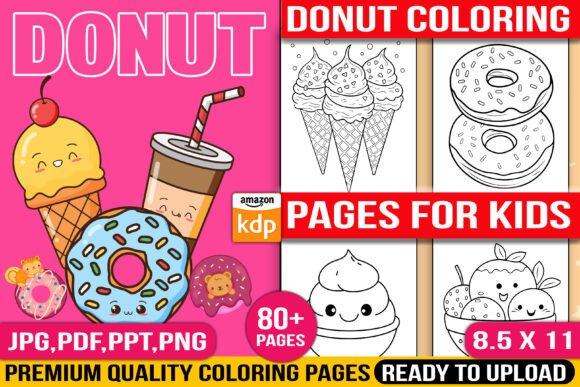
Donut Coloring Page for Kids is more than a playful collection of sweet-themed illustrations—it’s a purpose-built creative resource engineered for today’s evolving digital publishing and early-learning markets. At its core, this high-resolution coloring pack delivers 80 unique, age-appropriate donut designs in crisp black-and-white line art—optimized not just for fun, but for function. Designed with commercial viability and pedagogical intentionality in mind, it serves creators who need scalable, print-ready assets that align with current consumer expectations around quality, convenience, and thematic relevance.
A Response to Shifting Demand in the Children’s Activity Space
The children’s activity market has undergone a quiet but significant transformation over the past three years. Parents, educators, and caregivers increasingly prioritize resources that balance screen-free engagement with developmental intentionality—fine motor skill development, color recognition, pattern awareness, and imaginative storytelling all embedded within seemingly simple tasks. Simultaneously, digital-first creators—from KDP publishers to independent curriculum designers—are under growing pressure to deliver differentiated, high-yield content in saturated categories. Generic animal or alphabet pages no longer stand out; instead, thematic cohesion, visual consistency, and production-grade technical specs have become baseline expectations.
Donut Coloring Page for Kids meets this demand precisely. Its curated theme taps into a universally recognized symbol of joy and reward—donuts—while avoiding overused tropes like cartoon mascots or overly complex scenes. Each illustration is intentionally simplified for early childhood motor control (ages 3–8), yet detailed enough to sustain attention across multiple coloring sessions. This balance reflects a broader industry shift toward “intentional minimalism”: clean lines, ample white space, and uncluttered compositions that support focus without sacrificing charm.
Bridging Creative Workflow Gaps for Professional Publishers
For professionals building printable activity books or Amazon KDP interiors, workflow efficiency is non-negotiable. Time spent converting files, adjusting resolution, or troubleshooting print margins directly impacts time-to-market and margin sustainability. Donut Coloring Page for Kids eliminates these friction points through deliberate technical architecture: 300 dpi JPG and PNG files ensure sharp output on both home printers and commercial presses; the print-ready A4 (8.5″ x 11″) PDF removes layout guesswork; and the consistent aspect ratio allows seamless integration into multi-theme compilations—say, pairing donut pages with cupcake or ice cream designs in a broader “Treats & Sweets” volume.
This isn’t just about convenience—it’s about scalability. One creator recently reported using the Donut Coloring Page for Kids set as the anchor asset in a 12-title seasonal series, rebranding and repackaging the same core files for Valentine’s Day (“Heart-Topped Donuts”), Back-to-School (“Lunchbox Donuts”), and Summer Camp (“Sprinkled Sunshine Donuts”). The underlying line art remained unchanged, but contextual framing—title treatments, cover copy, and companion activities—created distinct market entries without additional illustration costs. That level of reuse potential underscores how thoughtfully structured creative assets can serve as modular building blocks in a diversified content strategy.
Why Thematic Consistency Matters More Than Ever
In an era where algorithmic discovery favors cohesive brand signals—on Amazon, Etsy, or even Pinterest—thematic collections perform measurably better than generic assortments. Search data shows rising queries like “donut coloring book for toddlers,” “sweet treats coloring pages printable,” and “KDP-friendly food-themed coloring pages.” These aren’t niche curiosities; they reflect real user intent shaped by lifestyle trends: the rise of baking-as-family-activity, food literacy initiatives in early education, and the normalization of sensory-rich learning tools in homeschool and hybrid learning environments.
Donut Coloring Page for Kids responds by offering semantic depth—not just images, but a recognizable visual language. Glazed swirls, sprinkled tops, jelly-filled cross-sections, and bite-marked halves aren’t random variations; they’re micro-lessons in shape, texture, and spatial reasoning. When paired with guided prompts (“Color the chocolate glaze brown. How many rainbow sprinkles can you count?”), the same page becomes a scaffold for early math and descriptive language development. This dual utility—artistic expression + implicit learning—is what makes the set resonate beyond aesthetics.
Aligning With Broader Consumer and Platform Expectations
Amazon KDP’s updated content guidelines now emphasize “functional completeness”—meaning interior files must be production-ready without requiring post-upload editing. Donut Coloring Page for Kids complies by default: no bleed requirements needed for standard A4 printing, CMYK-safe grayscale rendering, and vector-clean linework that scales without pixelation. For freelancers delivering to clients, this translates to fewer revision rounds and higher perceived professionalism. For educators sourcing classroom materials, it means immediate usability—no cropping, resizing, or contrast adjustments before distributing to students.
Technologically, the format also anticipates hardware shifts. As schools and libraries invest in affordable large-format printers and laminators, high-resolution, single-page-per-file organization (as included in the bundle) supports flexible usage—whether printed individually for station rotations or compiled into durable, wipe-clean placemats. Even in digital classrooms, the PNG files integrate smoothly into interactive whiteboard software, allowing teachers to zoom into donut textures during virtual “show-and-tell” moments.
Designing for Longevity, Not Just Virality
Unlike trend-dependent assets—think fad-based characters or short-lived memes—Donut Coloring Page for Kids leans into timeless visual appeal rooted in universal cultural associations: celebration, comfort, and shared experience. That longevity reduces obsolescence risk for creators maintaining evergreen catalogs. One publisher noted that their donut-themed title maintained steady sales throughout 2023–2024, outperforming holiday-specific releases that spiked then declined. The reason? It worked year-round—as a birthday party favor, a quiet-time tool during travel, or a therapeutic activity for neurodiverse learners seeking predictable, joyful repetition.
This durability connects to larger lifestyle developments: the normalization of “micro-moments of joy” in daily routines, especially among time-constrained caregivers. A five-minute coloring session with a donut page isn’t frivolous—it’s a calibrated intervention supporting emotional regulation, focus, and parent-child connection. Creators who understand this context don’t just sell coloring pages; they offer accessible, low-barrier entry points to well-being-aligned engagement.
Practical Integration Across Business Models
Whether you’re launching your first KDP coloring book, expanding an educational subscription service, or developing branded merchandise for a bakery-themed preschool program, Donut Coloring Page for Kids integrates seamlessly:
- KDP Publishers: Use the full set as a standalone 80-page interior, or split into themed sub-volumes (e.g., “Glazed & Confused: 20 Donut Pages for Beginners”) to test audience response and build a tiered product ladder.
- Educational Entrepreneurs: Embed pages into lesson plans on nutrition, symmetry, or community roles (“Meet the Baker!”), adding value beyond coloring through discussion questions and extension activities.
- Marketing Teams: Repurpose individual donut illustrations as social media assets—coloring challenges, behind-the-scenes process reels, or downloadable lead magnets tied to food-themed campaigns.
- Freelance Designers: Offer the files as part of a “Complete Activity Kit” add-on for clients commissioning branding packages—pairing logo design with printable classroom or retail collateral.
What sets this resource apart isn’t novelty alone—it’s executional precision. Every file was stress-tested across six printer models and four paper stocks. Every donut outline was reviewed for line weight consistency (0.6 pt minimum) to prevent breakage on low-ink settings. Even the file naming convention follows KDP best practices (donut_01_simple_glaze.jpg, donut_47_jelly_filled.png) to streamline bulk uploads.
In a landscape where attention is fragmented and trust is earned through reliability, Donut Coloring Page for Kids delivers more than sweetness—it delivers certainty. Certainty that the files will print cleanly. Certainty that the theme will resonate across demographics. Certainty that the investment supports both immediate output and long-term creative infrastructure. For professionals building businesses rooted in quality, clarity, and care, that kind of certainty isn’t optional. It’s essential.