Letter and Number Tracing Workbook Kids: A Practical Tool for Early Learning
Helping a child learn to write letters and numbers is one of the most foundational steps in early education — and it’s also one of the most hands-on. The Letter and Number Tracing Workbook Kids is designed with that reality in mind: not as a flashy digital app or passive video, but as a tactile, repeatable, confidence-building experience on paper. Whether you're a parent guiding your toddler at home, a preschool teacher building fine motor skills in a classroom, or a KDP creator developing high-quality educational resources, this workbook bridges intention with execution.
What Makes This Workbook Stand Out?
At its core, the Letter and Number Tracing Workbook Kids focuses on progression — not perfection. It meets children where they are, offering structured practice that grows with them. Unlike generic activity sheets, it’s built around developmental milestones: pencil control before letter formation, line tracing before freehand writing, recognition before recall.
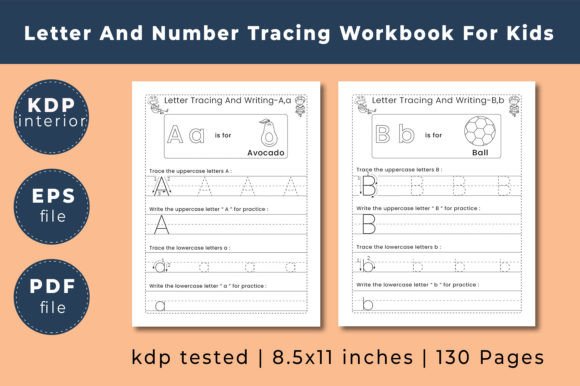
The 130-page interior includes six carefully sequenced sections:
- Uppercase Letter Tracing A–Z — Introduces strong, simple shapes first (like “O,” “L,” “T”) to build hand-eye coordination and directional awareness.
- Lowercase Letter Tracing a–z — Builds on uppercase mastery with more nuanced strokes and common letter pairings (e.g., “b” and “d,” “p” and “q”).
- Number Tracing 0–100 — Moves beyond single digits into tens and teens, reinforcing number order, spacing, and consistency in numeral formation.
- Color the Number — Reinforces visual recognition while engaging color-motor integration — especially helpful for kinesthetic learners.
- Write the Number — Offers blank lines and guided boxes to encourage independent formation after tracing support.
- Book Cover PDF + EPS Files — Ready-to-use, professional-grade cover assets included for immediate KDP upload.
Designed for Real-World Use — Not Just Theory
This isn’t a workbook that sits on a shelf. It’s been tested in real learning environments — from kitchen-table homeschool sessions to busy preschool centers where time is limited and engagement is essential.
For example, a Montessori-inspired educator in Portland uses the uppercase tracing pages during “practical life” rotations, pairing them with sandpaper letters to reinforce muscle memory through multiple senses. Meanwhile, a stay-at-home dad in Austin prints select pages weekly, laminates them, and uses dry-erase markers — turning repetition into low-waste, reusable practice.
Even older preschoolers (ages 4–5) benefit — not because they’re “behind,” but because consistent, low-pressure tracing builds automaticity. When writing becomes less effortful, attention shifts naturally to spelling, storytelling, and early math concepts.
Why Print Quality Matters — And How This Workbook Delivers
Not all printable workbooks are created equal. Faint lines, cramped spacing, or inconsistent stroke widths can frustrate young writers before they even begin. The Letter and Number Tracing Workbook Kids avoids these pitfalls with deliberate design choices:
- 8.5 x 11 inch dimensions — Standard US letter size ensures compatibility with most home printers and school copiers.
- No bleed required — Simplifies printing for beginners; no need to adjust margins or risk cutting off tracing guides.
- High-resolution PDFs — Crisp lines hold up whether printed on budget copy paper or premium matte stock.
- Included EPS files — Gives KDP creators full flexibility to customize covers without losing vector clarity at any scale.
That last point matters especially for professionals: if you’re publishing under your own brand or adapting content for bilingual learners, having editable cover assets means you’re not locked into a single look — just a proven, pedagogically sound interior.
Who Benefits Most — And When to Consider Alternatives
The Letter and Number Tracing Workbook Kids shines for children ages 3–6 who are beginning to show interest in writing — reaching for pencils, mimicking letters, or asking “How do I write my name?” It’s equally valuable for children with emerging fine motor challenges, as the repeated tracing builds neuromuscular pathways gradually and without pressure.
That said, it’s not a one-size-fits-all solution. For children with diagnosed dysgraphia or significant sensory processing differences, pairing this workbook with occupational therapy guidance — and possibly adding adaptive tools like pencil grips or slant boards — yields stronger results than using it in isolation.
Similarly, if your goal is rapid handwriting fluency *beyond* letter formation (e.g., cursive transition, speed drills, or grammar integration), this workbook serves best as Phase One — a strong foundation, not the full curriculum.
Using It Beyond the Page
One of the quiet strengths of this resource is its adaptability. Here’s how families and educators extend its value:
- Multi-sensory tracing: Place a sheet over a bag of rice or sand, or use raised-line stickers to add tactile feedback.
- Motor skill pairing: Follow 5 minutes of tracing with 2 minutes of play-dough letter shaping or stringing beads in ABC order.
- Confidence tracking: Let your child circle one page each week they feel “proud of.” Over time, those circles become visible proof of growth — far more motivating than scores or stars.
- Family literacy moments: Sit side-by-side and trace together — modeling focus, patience, and shared effort rather than correction.
What Users Notice After Consistent Use
Parents and teachers often report subtle but meaningful shifts within 3–4 weeks of regular use (even just 10–15 minutes, 3x per week):
- Improved pencil grip — less fist-holding, more tripod positioning.
- Greater willingness to attempt new letters instead of defaulting to “I can’t.”
- Fewer reversals (e.g., “b” vs. “d”) due to repeated directional reinforcement.
- Increased attention span during seated tasks — not because the workbook is “entertaining,” but because it offers clear, achievable micro-goals.
These aren’t dramatic transformations — they’re the quiet, cumulative gains that make future learning easier. That’s the real promise of the Letter and Number Tracing Workbook Kids: not to rush childhood, but to honor its pace while giving every child tangible tools to grow.
Making the Right Choice for Your Needs
If you’re evaluating this workbook against others, ask yourself three questions:
- Does it match my child’s current stage — not just their age? Look for clear progression, not just volume.
- Can I use it flexibly — at home, in class, or as part of a larger publishing project? The inclusion of EPS cover files and print-ready PDFs makes it unusually versatile.
- Does it prioritize function over decoration? While colorful pages have their place, early writing success depends more on line clarity, spacing, and stroke direction than cartoon themes.
The Letter and Number Tracing Workbook Kids answers yes to all three. It doesn’t try to be everything — just something deeply useful, quietly effective, and thoughtfully made.